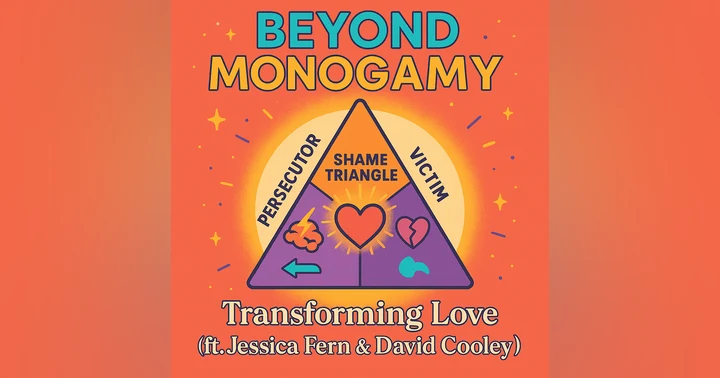

Transforming Love: Jessica Fern & David Cooley on Shame, Attachment & Polywise Relationships
Full Swap Radio: Thursdays at 1 PM & 6 PM CST Patreon (early access, After Hours clips, bonus minis, Discord): Show Notes Attachment & IFS: How to spot when a part (not your core self) is driving reactivity—and how to respond with...
Jessica Fern & David Cooley on Attachment, Resentment & Rewriting the Rules of Non-Monogamy
Guests: Jessica Fern (author of Polysecure, Polywise, and Transforming the Shame Triangle) and David Cooley (restorative-justice facilitator, creator of Restorative Relationship Conversations).
Episode Summary
In this heart-to-heart, Adam & Pris sit down with Jessica Fern and David Cooley to go deeper than “What is polyamory?” They unpack attachment styles, why resentment is jealousy’s sneaky cousin, and how the Shame Triangle (inner persecutor, inner victim, inner rescuer) quietly shapes conflict—and how to transform it with practical tools rooted in IFS and restorative practices.
The convo hits real-life dynamics: ditching the “50/50” myth, navigating capacity and time (especially with kids), and why relationships thrive when both partners bring 100%—just not in the same way every day. Adam & Pris get candid about their own poly chapter, burnout, and finding balance, while Jessica & David share how their post-divorce collaboration became one of their healthiest partnerships.
Keywords: Jessica Fern, David Cooley, Polysecure, Polywise, Transforming the Shame Triangle, attachment theory, IFS therapy, ethical non-monogamy, open relationships, jealousy vs resentment, relationship repair, capacity, family dynamics, Beyond Monogamy podcast, Full Swap Radio.
Listen & Subscribe
- Website: beyond-monogamy.com
- Full Swap Radio: Thursdays at 1 PM & 6 PM CST
- Patreon (early access, After Hours clips, bonus minis, Discord): Patreon.com/BeyondMonogamywith
Show Notes
- Attachment & IFS: How to spot when a part (not your core self) is driving reactivity—and how to respond with needs-based clarity.
- Jealousy vs. Resentment: Resentment is the “check-engine light” for unmet needs or long-standing imbalances—don’t villainize it, learn from it.
- The 50/50 Myth: Healthy partnerships aren’t perfectly split; they’re capacity-aware and transparent about changing needs over time.
- Polyamory + Parenting: Why time/energy constraints shift when kids are young—and how integrating partners into the family system can help.
- The Shame Triangle: Inner persecutor ➝ inner victim (shame) ➝ inner rescuer/escapers (over/under-functioning, numbing, projection) and how to break the cycle.
- Collaboration After Divorce: Jessica & David describe dissolving romance, rebuilding trust, and co-creating work that actually deepens harmony.
Guest Links & Resources
- JessicaFern.com — book info, events, workshops (New book Transforming the Shame Triangle releases on October 31; pre-release discount via site).
- Polysecure, The Polysecure Workbook, Polywise — widely available wherever books are sold.
- Upcoming signings mentioned: Asheville (Malaprops, Oct 28), Atlanta (Cherish Books, Nov 4), Bay Area events week of Dec 17 with a day-long workshop on Dec 22.
Favorite Moments
“Resentment is a really important signal—like a dashboard light. There’s a need underneath it asking to be seen.”
“Stop chasing 50/50. Bring your 100%—and expect your partner to bring theirs—in ways that ebb and flow with real capacity.”
“The Shame Triangle links that inner critic, the shame it creates, and the ‘escapes’ we use to avoid feeling it. Naming it is the first step to changing it.”Timestamps
- 00:01 — Meet Jessica & David; books, backgrounds, collaboration
- 16:00 — Sacredness, conditioning & rethinking mononormative scripts
- 18:00 — Jealousy vs. resentment; needs, signals & repair
- 22:00 — Ditching 50/50; capacity, boundaries, expectations
- 29:00 — Poly + parenting; integrating partners into family systems
- 44:00 — The Shame Triangle explained (persecutor, victim, rescuer/escapers)
- 54:00 — Why feedback can trigger shame—and how to receive it better
- 55:00 — Book release timing & event tour details
Support the Show
Love the conversation? Join our Patreon for early access, After Hours clips, bonus minis, Discord hangs, and more. Catch us on Full Swap Radio every Thursday at 1 PM & 6 PM CST.
Follow us: Facebook @BeyondMonogamy4U • Instagram @beyond_monogamy_4u • TikTok @beyond.monogamy & @adam&beyond • YouTube @BeyondMonogamywithAdamPris
0:07 Alright y'all, before we dive in, a quick heads up. This show is raw, real, and definitely not rated pg. We're talking about adult themes, sexual content, and the kind of stuff you probably don't want blasting through your speakers at work or around your kits. So grab some headphones, pour your drink of choice and get comfy. Oh, and just so we're clear, we are not licensed therapists, counselors, or sex. Couches. Sex coaches. Sex coaches, not sex couches or just a couple of people sharing our lives, experiences and sexy adventures.
0:47 An ethical non-monogamy. So with that, pull up a chair and enjoy the show. And. Hello, and welcome to another episode of Beyond Monogamy. I'm Adam. And I'm Pris. And today we're sitting down with two of absolute legends in the world of open relationships and emotional intelligence. Jessica Fern and David Cooley. You might already know Jessica's name. She's basically the Beyonce of polyamory books. Oh, she wrote PolySecure, the PolySecure Workbook, Polywise, and now she's got a brand new one out called Transforming the Shame Triangle. Yes. This woman is no joke guys. She's got a master's in conflict resolution.
1:27 She is a certified clinical trauma professional. A trained internal family systems practitioner and has over 25 years working with folks all over the world on attachment trauma and non-monogamy. Basically, she helps people stop repeating the same emotional patterns and start creating love that actually lasts. And then there's David Cooley, who, let's be real, is the calm, grounded counterbalance to all of us emotionally chaotic people. Yeah. Yes. Yeah. Just like me. Totally. He's a professional restorative justice facilitator. A diversity and privilege awareness trainer. Yeah. And the creator of the restorative relationship conversations, which helps people turn conflict into connection instead of World, world iii.
2:13 Instead of what now? World War. I can't say it. It's World War iii. There we go. One of us can use that one. All good. So David's got that deep, mindful approach that just makes you feel seen and sane again. Together they've shaped how we understand attachment repair and the emotional side of non-monogamy, and they do it with actual heart, not jargon. So today we're not doing the basic what is polyamory thing? We're going deeper. The messy, the funny, the uncomfortable, and the real life parts People don't usually talk about. Yeah, we're talking co-writing chaos. How Resentment is Jealousy's Sneaky Cousin, and those weird little relationship experiments.
2:57 That sound great in theory, but go sideways fast. So grab your coffee, grab your partner, and let's get Polywise with Jessica Fern and David Coley. That's right. Welcome to the show, guys. Welcome. I told you it was a relief. Oh man, I do. That was a long one. That was, I, I gotta admit that was the longest one. It is because I was so excited to have you guys, and I was like, that goes down in history for our best intros. That's right. That's, that's definitely the highest the bar's ever been set in an intro. Well, so I, I figure in the very least, at least the intro would be good if the rest of the show fails, they can drop it from that point. So, and then go read your book and That's right. That's right. There you go. That's right. That's gonna be the, it's gonna go from the intro to the outro and it's gonna say, just read the, you'll get everything from the book.
3:39 All I love it. So, uh, you know, before we get started into the talking points, which I have several I really want to familiarize our audience, our listeners with not necessarily who y'all are as writers, but maybe a little bit more personal. And if I could start with Jessica, how, how did you find yourself in the world of non-monogamy? Yeah. As a professional or as personally? E Either or actually, or both. If we could, you know, I wanna know personally. Yeah. Yeah. I mean, personally it was like being 14 and kissing a girl, best friend with a guy at the same time, and just being like, oh, this is a thing.
4:20 Nice. Yeah. Yeah. I mean, sometimes it's just as simple as that. Yeah. As simple as that. Right. And then there's, you know, iterations of it throughout time. Yeah. And then eventually it led you to your professional journey. It did. Right. And that really felt like it came to me where I was working as a therapist with couples and in one week all of my therapy couples clients brought to session wanting to open up their relationship. And even though personally I had experience or known about it professionally, I was like, oh, the only thing I know about this is that it's pathologized. Like what do I do? And so I really had to figure out how to support my clients.
5:02 Right on. Well, you know, moving over to David. What about you my man? I mean, so this world of ethical non-monogamy, how did you find yourself in. Basically Jessica told me we were gonna be doing it, so there's no other choice. That's, I found myself doing the podcast for the same reasons. Yeah. I mean, not that Jessica told me, but my wife told me. Yeah, that's right. No, she, in that same anecdote where she was starting to get exposed to it through clients' inquiry, it became something philosophically intriguing for both of us. And so that's something that we've really connected on deeply is intellectual, emotional stimulation. Whenever there's something that's intriguing to one, it's usually a crossover for both.
5:46 And so we started to really think about it. So we went into a deep dive of what are the implications of it? What are the philosophical principles and values that really feel compelling to us about this? And so I think it was about six, seven, I don't know, kinda six month, eight month window where we started to really say. Is this something that we could do? Mm, right on. That's awesome. Yeah, we, we kind of did that, that for a little bit. Yeah, you could say that. You could do that. Yeah. I, um, we started doing the poly thing and I did not care for it. Well, so, because I was, so, I was 40. I was 40 and Yeah.
6:27 You were in your forties. I was going through menopause. Yeah. I was about three hours away from my kids and my husband. And it just was not oof, wasn't a good time. No. Mentally a for me was not a good time. I had not been diagnosed. Um. So when I went to the doctor and they told me, I was like, oh. I mean, I could tell that my emotions were off. And so like, I was like, Ooh, we're not doing this Polly thing anymore. I, on the other hand, had a really good time as Polly. Um, you know, I, it, it really, I mean, it served its purposes for us Yeah. In that it really helped us learn how to communicate, which I think was incredible. 'Cause I thought we could communicate well before, and apparently we did not.
7:08 Yeah. Yeah, I mean that's, we, we definitely had our, our, uh, our wrestles with it and it's still it's still in the air, which I love. Yeah. But yeah, you know, I'm not gonna. Guys, I'm not gonna hold you up. No. I'm gonna talk about my son full day long. Yes, you will. Jessica, I see your, your happy smiling face in front of me here. I have a question for you. We're gonna kick this off real easy. If your partnership or collaboration with David was a movie, what would be the behind the scenes moment that never makes the trailer, but totally explains how you two work together? Oh my God, I need Dave to answer this one too. Yeah, well, you guys are collaborative. I mean, yeah, yeah.
7:50 Is it like us having these conversations about big things like while making lunch and breakfast for our son? Yeah, could be. Could be part of it, yeah. Mm-hmm. Yeah, like a little rom-com. That would definitely be ours. Yeah. Or Rambo. I mean, one of them. Yeah. Well, you know, um. In our relationship. 'Cause you know, everybody's gotta have that balance in our relationship. I'm the, uh, the positive, happy one. Pause, right? Oh, I wasn't, if y'all were expecting me to finish that I wasn't, I just, I would rather label myself and you guys figure out the rest. Okay. That's right. Well, in that case, in that case, our roles are reversed, Adam. 'cause the, one of the behind the scenes things that I would never want anyone to see is my mental and emotional breakdowns that Jessica has to hold infinite space for.
8:39 That's probably something that you wouldn't want to see unless you were really into sensationalism. I, I, I get it because as soon as I turn this off, I have my mental breakdown, but she doesn't comfort me at all. She's parting it. Okay. She's so, yeah. You're unlucky. And that's, I won, I won the lottery. Yeah. Yeah. She is not my fixer. I'm actually like you, David. So I do have those little mental breakdowns and it's like. Oof. And yeah, he has the mental space for it, which is amazing. But then he has a house full of those because most of our kids, we have a lot of kids. The same thing. Y'all have one, right? So we have, we have one. How many do you have? We have five, four in the house. And they're all for blended family. So the oldest one is out of the house.
9:20 She's 26. But the four that are here, they're all the same age. So we have two 19 year olds, girl, boy, 14 year olds and two 14 year olds boys. Oh, wow. And two are mine and two are his. And yeah, it's, um, it's a chaotic little life. Yeah. But it's fun. Do you know how I said I quit the show 40 times? I tried to quit being parenting, uh, and doing all that. At least more than that. But it never happened. Like I, by law, I think we have to stay here. So I have a, I have a really good question. So, and I have to know this. So when y'all two write together, who's the. Who's the chaos gremlin? Like who's the one hitting sends on half finished drafts and saying, we'll fix that later.
10:02 I kind of have an idea of who it is, but Oh, that's funny. Well, Dave's always a gremlin. That's, I, I prefer the term curmudgeon. Curmudgeon. I like it. Yeah. That's my, that's my spirit animal. That's my total. Yeah. Yeah. I'm the half finished person. Like I'll start something or I'll do like 20 little things and then come back to it. So yeah. Her squirrel moments are, are very, I have many TikTok drafts I have not posted yet for the, the role that we play often. 'cause we're a partnership. Often she comes up with a billion ideas and I have to be the one to put them, in motion. Yeah. And so I'm constantly putting things in motion that I know aren't gonna go anywhere, but I'm like, okay.
10:47 Whatever you need, you know? We'll, and now we're here. Yeah. Because this is right. I think one of, one of the best ways to understand our dynamic is through two different personality assessment models. You know, one is the Enneagram and one is the Myers-Briggs. Do you know anything about those systems? I do. I know about the Myers-Briggs. Yeah. Okay. So Enneagram is another typology, which is really interesting. There's nine different types, you know, but within that, an infinite world of complexity and nuance. Right? And so on the Enneagram, I'm a five, which is the investigator, very mental type. Mm-hmm. You know, and with that comes a very perfectionist, especially around language, because that's a primary way that I express myself or identify myself in the world.
11:29 So for me, there's a lot of perfectionism, there's a lot of over fixation on the structure of language. Whereas Jessica's a nine, which is the peacemaker, has kind of a more balanced global approach to things, which is super helpful. So there's a balancing in terms of, I like to really refine and refine, refine language. And Jessica has an overarching structural. Understanding of this is what people need to hear. This is how you humanize language so it doesn't sound like a robot. Mm-hmm. Uh, that's a nice way we play off each other. Yeah. From the Myers-Briggs perspective, I'm at INFP and she's an INFJ. These are two supposedly the rarest types on the Myers Briggs system, and it's, the real difference is that last letter, the P and the J, she has the JI have the P, which is perceptual, a feeling kind of intuitive relationship to information organizing.
12:24 Whereas that J is judgment, I forget, it's like the judging type. It's not like judgment in terms of being critical, being a judging person. Yeah. Or how you, it's just the way a cognitive cognitively organized information. I've known a couple INFJs like her, and they have the, it's this superpower. They have this. Spiritual, emotional, intuitive flow, full, beautiful doubtfulness that I have. But that last letter, that J that she has, allows her to condense it, consolidate it, and express it in a way that's super organized and super easy to digest. I would give an organ to be able to do what she does, but it's this critical piece in our relationship where she's able to really hone and craft and sort of direct our efforts in a way that makes it really.
13:13 Sweet. I like that. So there's no throwing laptops across the room type of you ate? No. And you know what, I'm, I'm, if you don't mind, I'm actually gonna quote you on that. Put it in a Hallmark card and I'm gonna give it to her. Yeah. Wednesday. You know, that's, um, because that was actually really sweet. Yeah, nice. Those is really good. Yeah, those are really good assessments. Because you have to know, right? Like what, yeah. You have a relationship with your partner and it's great, but when you start working together, it can get a little chaotic. I mean, I love working with Adams. Yeah. He makes me laugh all the time. So this is us. Perfect. Yeah, this is me all the time. This is us all the time, right? Um, I'm always rolling my eyes. I'm always like full, like I'm a lot. Yeah. And I'm normally very caffeinated.
13:53 Yeah. He's the, you know, he's the funny one. I'm more of the cynical one, you know, and, and it, and we kind of balance off and we kind of work together really well, but. Doesn't work for a lot of people usually, so, no. Yeah, I, I see the good in everybody. You know, I love everybody the first time I meet them. Oh, wow. Um, it, it takes a lot for a person to make me go, okay, I need to stay away from that person. Yeah. 'cause they're just too toxic. Yeah. It normally is like, third strike, you're out. Okay. That's enough. I can't keep you around anymore. But now I gotta do that Meyers thing. 'cause I'm probably just Myers Briggs. Meyer Briggs, just like Myers thing. The Myers thing, you know, the US Meyers-Briggs thing for, for lunch, because I'm probably aligned more of, I mean, I don't know.
14:37 I wanna say there's probably a J there and it's probably, it's probably for the judgmentalness of my brain. Yeah. It's worth, it's worth doing. It's, yeah. Yeah. And, and the Enneagram too is fascinating. It's actually been helpful. I'm gonna have to check out that other one. I hadn't heard that one before. Yeah. Yeah. I, yeah. It's pretty awesome. Yeah. Believe it or not, I'm actually very introverted, so. She's the extrovert when it comes to the two of us. So, uh, but I do well when it's when it's via Zoom. Great. Obvious. That's good to, I'm also, I'm also extroverted on Zoom. It's amazing. You're you're good at this. I can, I can see you, right? I feel like you're here now. You're, you're co-writing is a brave move.
15:20 Mm-hmm. You know, I, I think most couples can't even decide on a, a Netflix show. Really. Yeah. Yeah. But I think that's, I I always liked that y'all really came together and created something that I just think is, is really, really cool. Yeah. You've both talked about paradigm shifts about beyond mono normative conditioning. Mm-hmm. What's one old belief that still tries to creep up on you even after all of this work? Hmm. I would say one that's still hard to deconstruct is around sacredness and sex. Sacredness and sex. Yeah. That it's, what do you mean by sacredness? Like mm-hmm.
16:02 And it comes up a lot. And maybe it's also 'cause I'm seeing it, you know, like there'll be kind of themes that show up through the years where like, oh, everyone's trying to deconstruct this thing. Gotcha. And then a few years later it's like everyone's deconstructing this, you know? Mm-hmm. And I'm seeing a lot of people, right. And they're like, it's hard to say like, oh, but the sacredness of sex between two. Right. And then it's like less sacred if you share it with somebody else. Right. Yeah. And so we're helping people through that of it's not necessarily less sacred. It can be sacred in different ways. Yeah. I'm actually learning that. Yeah. And being that we've been in it for so long, so that's interesting. Yeah. That does creep up pretty often.
16:42 Well, you know, we're, uh, oftentimes raised and a lot of people are raised in a religious space that mm-hmm. Preaches, one-on-one partnership, uh, or what you share with your partner, you should share with anybody else. And, you know, procreation is what sexual, uh, reasons are for, and this and that. And so we are raised to, to feel this. We share this. Sex with a person that we love and adore, and this is the one person we're gonna do it with. Right. Um, and so I feel like non-monogamy is really starting to reach, its, its mainstream now, especially after the pandemic and people are starting to realize that, hey, it's okay.
17:24 It's okay to love more than one person. I always liked the example that people would throw out, which is, well, are you a parent? You have more than one kid. Right. You know, do you love one over the other? Obviously we have a ton of kids and I love them all equally, but all in different ways. Exactly. And I bond equally with them, but all in different ways. Yeah. Um, and I don't think that people can really apply that to romantic relationships. And I think that's where we get caught up in that, that stigma. Yes. You know, everyone loves to talk about jealousy. And I think jealousy is really villainized.
18:05 But what I really want to talk about is resentment. It's that that slow burn emotion that ruins the vibe if you don't catch it. How do you both spot it and how do you deal with it before it gets toxic? You know, one of the systems that we're both anchored in, in our work is the internal families work. And that's the difference between being grounded in your sense of self, kind of your core essence versus a part, right? Having a part of you that's carrying the memory of something painful and sort of. Influencing your behavior in the moment when something uncomfortable like resentment comes to the surface.
18:46 So we're really teaching people how to differentiate in our work between self and part. What is a part? What is a self? What do they look like? What do they feel like? One of the things that makes recognizing parts easier is to listen to their stories, understand what the emotions are that are attached to those, right? And then try to figure out what are the needs underneath. And so usually resentment is a really important signal. Kind of like on your dash dashboard of your car, right? It's like, okay, the motor light is on, resentment is flashing. What is it that we need to look at? There's a part that's speaking here. So for us, it's usually an indicator that there's some kind of need underneath.
19:28 The person's experience that's not being addressed. So we're really using it as a way to find ourselves to the need versus seeing resentment as fundamentally problematic or something that we need to stop or shut down or fix. We really wanna invite it to the surface and explore what is it trying to tell us about our lived experience. Mm-hmm. Right on. I like that. Yeah. And I would add that it's often pointing to an longstanding dynamic where there's been an imbalance between two people. If someone feels like they've either been over-functioning or, and the other partners been functioning, or I've been absorbing things, or I haven't been speaking up for my own needs and boundaries.
20:13 So there's some kind of dynamic like that. And then therefore resentment is building. Wow. And I, I would figure it's rare that new couples that get together. Automatically reach that space where they're on the level, they're both on the same level. I think that there's more push and pull at times when it comes to relationships normally. Right. I mean, there's a lot of, you know, one person takes the role a bit more. Yeah. And the other person gives more and that sort of thing. And then over time they figure it out. Would you say as, as you found? Yeah. Yeah, of course. Right. Well, that's one of the misnomers I think about the work on the surface is that everything's supposed to be fair or balanced.
20:56 And that's not usually how relationships are. There's usually fundamental stark ba imbalances in people's dynamics. And so we're wanting to dismantle or deconstruct this idea that things are supposed to be fair or 50 50 'cause that's usually not how things work. And so what we're trying to figure out is what are the actual needs that are trying to be met here in a relationship? And then try to leverage those needs to create more of a sense of balance. It's not that you don't have a sense of balance, but we're not trying to create sort of this, you do this, this much, I do this this much. What are the lived experiences? What are the strengths and weaknesses?
21:36 What are the, what are the wounds and traumas that we have that we're trying to heal together in the context of the relationship? Yeah. You know, I, I think, uh, people are, are much more fluid and there's just so many different things. None of us can fit into that one box. Mm-hmm. Um, and so yeah I don't know if it's even really possible. I always wondered, and I'm kind of curious on your thoughts as far as, uh, when it comes to relationships, whether it be one-on-one or one-on many. What kind, you know, I. I know people that are really big into the 50 50. We were at one point when we got together of it being 50 50. Now we've reached that point where it's like, it's give and take.
22:19 Some days it's, it's 60 40, you know, some, or is that math right? Yeah. Okay. Better be that's off the cuff. You know, some days she's giving more and I'm taking more, and, and some days it's vice versa. Yeah. You know, there's never really days where it's 100% 50 50. That's right. But we give this perception like it's 50 50. Yeah. Would you say that in, in pretty much most relationships, it's rare that 50 50 is actually a thing. I mean, that would take like real organization, David, like you were saying, like, you, you take care of these, I'll take care of these.
23:00 You know what I mean? And we're good. Yeah. Yeah. I think a lot of times, well, yeah, I don't think relationships are actually functioning in true 50 50 for sure. Yeah. It's, that's hard. Yeah. Well, and and why is that the goal? I think we should even explore that. Ah, like what, you know, like, I think it comes from gender equality being something that is still getting figured out and has been very important. And then we're imposing, you know, an important systemic concept of gender equality into the nuance of a day-to-day experience between two partners. It doesn't translate in that way as 50 50.
23:43 And that becomes even more important in the context of polyamory or ethical or consensual non-monogamy, because you're not working in a dyadic framework often. And so one of the things that I think has been helpful to understand for people as a litmus test for balances, what is real capacity? Yeah, and capacity is a fluid thing. Kind of like what you were saying in a moment ago, Adam, right? Some days my capacity's higher than others. Some days my needs are different, and so being able to think in terms of what's realistic, in terms of what I can offer you, right? In terms of proximity, attention, safety, respect, trust, express, desire, all of these fundamental attachment needs that we have in relationship, those things are shifting.
24:30 What I'd rather see is people be able to know their own barometer and be able to communicate that in a way that feels transparent and not dictated by emotional survival strategies, right? I can authentically let you know what my boundaries are based on my sense of needs. And there we go. Back to that question of resentment. You can often bring down the temperature of resentment, right? When you have a really clear sense of what your needs are and you know how to communicate them in a way that's relational versus adversarial. Sure. Oh, now that's very well put. I'm sorry. Go ahead Jessica. Yeah, I think too, what often happens is this whole idea of 50 50, even though it makes sense, it sets us up to be in an adversarial position with our partner.
25:15 Like, I'm doing my half or you doing your half right? And then we're like keeping track in this way. And so what I find in the couples that are actually thriving, um, is their approach is I am a hundred percent responsible for this relationship. And so is my partner, but I am going to show up with my a hundred percent. And then obviously I expect that too of my partner. But that ebbs and flows like we've already been saying. Sure. Yeah. And you know that can really apply well to a one-on-one relationship, but when you open it up to a few more and you're trying to keep as much of yourself in each and every relationship, and you're trying to put your best in every relationship, even your relationships, I would think wouldn't all equally be they're not.
26:04 That's right. Be equal. You would have, yeah. You'd have one relationship that was really like, you're putting way more into it. You'd have one relationship that's probably a bit less, and even one that's even a bit less than that. 'cause it, I mean, it takes, it takes a lot out of you. Yeah. It's, it's exhausting. That's really a good point, especially for the ethical non-monogamous community because the. Partnerships or the constellations of relationships that I see struggle the most are when people are trying to take this static model of my a hundred percent and then do that here and then here. Whereas the partnerships that do the best are the ones that have very specific needs that they're recognizing can't be met by a certain partnership, and then they're using other relationships to get those needs met.
26:53 But it's very explicit and everyone in that system is really understanding what the roles are, what the needs are that are getting met. These are the constellations of relationships that do the best, and they're working within that framework of, this is where I get these needs met and my expectations are now not on this other relationship. And so they're not trying to reproduce the same amount of attachment or the same amount of connection in all of the relationships. Not to say that you can't. I'm just talking anecdotally from what I've seen, right? Sure. Yeah, sure. That has to be really hard. I mean, we have a lot of friends that are, well, we have a couple of friends that are poly and they just have like one partner each, and I don't know how they make it work, but I just sit back sometimes and I'm like, wow.
27:40 Because I've seen them, I've seen the husband and the wife together be great, and I've seen the girlfriend and the husband together and the wife and her boyfriend together, and it's like, wow, you guys can make this all work works so well. I just I don't know, my, my brain hasn't wrapped around that kind because I am the person that's like, well, if you're, I want you to give me a hundred or 50, but I only want you to give them. 10. Like, I wanna be in control of that. I just want you to give them like 10% of your, your emotional. And if I'm not feeling good, it needs to be less than Yes. So that is very hard for me.
28:21 It was something, well I'm, we're not, he's gotten a lot, we're not Polly, but better every time. We have people that like, like y'all selves, um, give me little tidbits and they, I kind of take it all in because you're right. You know, everything I was raised with is still in my brain. Mm-hmm. I have to learn how to, if I want it to grow, if I want the relationship to grow, you kind of have to like figure it out, somehow, whatever works for you, but figure it out somehow. Yeah. And a lot of the things that prevent you from growing are a lot of insecurities. Yeah. And as you let them go, you get to grow and resentment. Uh, yeah. Yeah, yeah. Yeah. It's crazy. And then you have the, you're a family too. I mean, you have five children. Yeah. So I see that with people, couples that have children.
29:04 It's very different. 'cause you're like, this isn't just, I'm getting less time. Yeah. With you as my romantic partner. It's like our family, our children are actually getting less time and, and that becomes, an area. Yeah. That's really where I struggled because it eventually, it became less of a, well, I can't share you romantically. She didn't care about that. It was the time. Yeah. Yeah. Um, I'm, I'm very close to my kids. I even homeschooled them for a spell. Like, I, I spend a lot of time with them. Yeah. And all of a sudden I was shirking time with them to go take a girlfriend out. Yeah. And it didn't make me feel comfortable. I know it bothered her, but it bothered me even more.
29:45 Do you, do y'all see that a lot? Do you see where it's like the family ones don't really. Like it's, it's easier for single, single singles to be in a poly relationship or married. Yeah. Well, no, I, I definitely know married couples that are thriving Polly. I see. The ones that are doing it the best either don't have kids. Mm-hmm. Or their kids are older and out of the house, or like older teens and they're not needing as much family intensive time. Yeah. And I see the families that are trying to do poly and they have younger kids, or kids with special needs or higher needs, it's harder to have more, other attachment based relationships.
30:28 There just isn't the time. Yeah. Yeah. Yeah, that makes a lot of sense. What now? In the, hold on, I'll add, unless those relationships can come into the family system. Ah, that's when then I see it actually. Yeah. Oh, I've, I've seen that before. Yeah. Right. And we have a version of that actually, where like, our partners are a part of our family system and therefore it doesn't feel like it's taking away from our family. It feels like it's really adding. Yeah. And in our context to be transparent. Jessica and I do not have a sexual or romantic part of our relationship anymore. Right. And so that dissolved when we got divorced. Um, but, and that changes the way that, at least for me my attachment system feels in relationship to Jessica.
31:15 Yeah. So we actually, one of the interesting things is when we were married, we were always talking about some point we're gonna collaborate professionally and do this relationship work together. And that never happened until actually we went through the divorce, spent time apart, and then came back together as a new system. Uh, so it's been a really interesting twist of fate in that sense, but it makes sense to me now in retrospect, and this is actually one of my favorite iterations of our relationship, because there's a certain ease and fluidity and functionality and harmony to our system that wasn't present and the same way when we were married. So I think that is so cool. David, like, so beautiful. I think that's really awesome because you guys went from doing this personal, very personal relationship to walking away from it in, in that moment and being able to come back together and collaborating on a whole nother relationship.
32:11 Mm-hmm. Yeah. And, and it's nothing but positivity. I love it. 'Cause I'm a positive guy and, uh, well, when we, when we tell people what we're doing, you know, unless they're really embedded in this subculture. Yeah. There's a lot of double taking. There's like you're living with your ex-wife, you know, and it's, it's interesting because right now in my practice I have a lot of partners who are dissolving a lot of marriages that are deciding to go their own way. And it's been really fascinating to watch how the hardest part of that for them, aside from the unraveling the attachment system. And what that can do to your nervous system and your emotional experience is the family systems that they're embedded in that are constantly deriding, their desire to have a conscious uncoupling, to have a peaceful and harmonious and non-contentious disillusionment of their connection, that people around them are saying, what are you doing?
33:05 Yeah. Why are you still trying to have this kind of intimacy, whether it's intellectual or circumstantial with your ex. Mm-hmm. Right. Or soon to be ex there's like this. Fomenting of conflict that's happening in sort of the outer concentric circles of these people's inner relationships. And it's, it's interesting to watch that because people don't have a model for this kind of thing that we've done. And I think it's one of the most powerful sort of gifts that we're giving, um, is just to show that yeah, it can happen. It doesn't have to be that way. I think, uh, it's very black and white. Sorry, Jessica. Go ahead.
33:45 I was gonna say, it's such a binary. You're either together or you're exes. Yeah. And that's, and that's the way we're kind of raised. You know, it's like there's no in-between, there's no gray area. You're either, you know, you're either with them or you hate them. Yeah. Yeah. Um, and they have to stay away from you. Which just so happens to be the case for both of us. But it's not always the case. Like, um, there's a lot of people that operate in a very gray area mm-hmm. Where it doesn't have to be black and white. Um. I think especially when you're co-parenting, you really have to play in that gray area as much as possible for the sake of the kids. Yeah. Um, because, you know, even if there are other partners around, you know, we, we are non-monogamous, our exes are not.
34:31 Mm-hmm. And we still have to co-parent with them. And so we still have to continue on this relationship with them, to work with them for the sake of our kids. And, uh, you know, some people get along better than others and some people can really pull it off better. And I, I think that the fact that you guys can work together, I think that's incredible. Yeah. You know, that's, that really says a lot about your emotional intelligence, uh, because I think that there's, that's something that's just missing oftentimes, yes. Well, you, you were asking earlier about. What are some of the hangovers of the monogamous paradigm on our lived experience? And I think actually this is one of the Le Lesser talked about facets of mono normative culture, which is that sort of black and white reader together.
35:17 We're not. And if we're not, then basically there's this contentious relationship that we have. You're out. You sure you're in or you're out. And I think that's something that's actually a hangover of mono normative culture as well, because people are not as used to just not modeled. To be in the gray area. And this is really what I think the culture is lagging in is this, how do we safely navigate the gray area until a new paradigm can really solidify and emerge out of this chaos. Right on. That's very well put. Oh man. David feel so enlightened right now. So I gotta ask you, David, because I'm already on you right now.
36:01 This wonderful experience of non-monogamy. I mean, obviously you're, you are working in the field. Uh, what would you say is your, the biggest learning experience that you've come across? Like mm-hmm. Like, uh, in this entire time, like obviously everything is a learning experience. Every day you're learning something new. Every time you establish a relationship, there's always something new. But that one monumental piece that just kind of made you sit back and go, huh, okay. You know, this one's gonna stay with me for a while. Yeah, that's easy. When we started to fall apart as a married couple and I started to really exhibit extreme behavior, what I now know was essentially a form of primal panic.
36:52 It forced me to really confront attachment and what my attachment system was doing. It wasn't until Jessica basically put a hard, I'm not talking to you until you read the description of anxious attachment style and the way that that manifests when it's totally dysregulated. Yeah. That I really started to have probably one of the most sober reckonings of my life with my own nervous system, my own organism, my own just totality of being, and that's been the thing that still I'm in awe of in doing this work with partners is just how powerful the attachment system is, what it can make you do.
37:36 Right. When I was in restorative justice, a lot of the cases that we couldn't touch were domestic violence or domestic abuse. You like where I was specifically, you know, cops would want to refer cases to us and by law in this state, we can't. You know, it's interesting, you know, hearing the stats coming back from police and what they were saying is, you know, over 75% of domestic abuse cases deal with alcohol. Oh, wow. And so I'm someone who doesn't drink. And I remember thinking about these extreme moments when I was going through primal panic and I was like, wow, if I had been drinking in those moments, it would've been so easy to have just done something absolutely catastrophic and irreparable.
38:22 Sure. From one perspective. And so it's just that in and of itself is just what the attachment system can make us do when we don't understand it, that it's true influence on us as human beings with nervous systems, I think is still one of the most awe-inspiring facets of this. For me, I love, you know, that can really apply to a lot, you know, when people are always afraid of what they don't understand. Uh, and, and I think we run into that a lot in this, uh. This arena. Jessica, I'm kind of curious about this, about your answer on this one, you know, in, in your time, going all the way back to 14 and up in that time, what was that learning?
39:05 You know, what, how was that learning experience? What was that number one? Just revolutionary. I got it. And this is gonna stay with me for life. I don't know if I have a number one. Really? Yeah. Really? Yeah. I don't think I have a number one either. Really? I have a lot. It's so, it's so white and black for me. Y'all are in the gray area. Yeah, right. It's okay. I like gray. I think there's something that's matured in me, you know, is like, there's been there's a lot of moments of identifying certain ways, being excited to identify those ways, feeling liberated to identify those ways. And then realizing, okay.
39:47 Just because that's who I feel myself to be or how I identify myself doesn't mean that's always what I do. Because it's not always what's best for even me or those around me. Right. I was joking with a client yesterday, she's poly saturated at one. Right. And someone else earlier this week was like, I'm poly saturated at zero. You know? Yeah. So I think like, yeah, that would be one. Well, you know, and I, it's funny that you bring that up. 'cause when we were poly and I remember trying to find different communities and I think we were on Facebook groups and things like that, and we were trying to find more people like us, and we were trying to get more information, which, uh, one thing that I ran into was a lot of people were not very helpful with giving information.
40:33 Everything is, uh, Google it fool. You know, it's like that kind of attitude about it. But. We were trying to really find our footing and we used to see people who, it was almost their goal to have as many partners as possible. Mm-hmm. Yeah. And I mean, there was one person that I, as ridiculous as it sounded, 15, 15 partners. And it just, I, I remember sitting back going, how do you put yourself in every single one of those? Yeah. And, and it was kind of cleared up to me after a while, which was, you know, they had different bondings with each and every one of them.
41:13 Mm-hmm. Yeah. And that was, there was no real definition to their relationship. It was just what worked, you know, and this what, this is what works for us and there's no real they're just my partner and this is what we do together. And so I kind of understood that, but at the same time, I'm like, man, that just. That is overly polys saturated to me because I, I wouldn't have been able to handle more than one other relationship. Yeah. And I think the struggle for me when I was poly was when I, I, I had a girlfriend and I had my wife. My primary relationship is really good. Mm-hmm. And it always has been, and we've always had this thing figured out and we don't have stress in our relationship.
41:55 But then I'm dating somebody where it's starting to get stressful, it's starting to get difficult. I have to learn how to figure this person out and what, what the gives and takes are, and I have to learn how to make this work. And I'm like, I'm putting myself through this stress and it feels so unnecessary because then I gotta go home to my happy relationship and go, ugh. I'm exhausted from this side relationship that I'm doing. You know what I mean? So the one other relationship for me felt like saturation in and of itself, but I, I, I, I know that, that people are on different levels, so Yeah. And probably the word the way partners being used is different.
42:36 Like your kind of using it like capital P partner, right. Like full in relationship. So yeah. Two is plenty. Yeah. I'm assuming the person with 15 is using, like, there's some lowercase P partner, you know, someone that they see once a month, once a season, you know? Yeah, sure. With people that they see more regularly. Yeah, of course. Yeah. No, I, that makes sense. And thank you for enlightening me there because, you know, I, I need other ways to think of things. I think that's why we're all here. Uh, now, speaking of which. You know, you guys have written some pretty amazing books. I want to talk about this new one that you guys have coming up. 'cause I know that it's not really focusing on non-monogamy per se but transforming the shame triangle.
43:22 Please fill me in. Um, you know, I, I did, I did a little bit of, uh, reading, which sent me, I, I loved it what I saw, and I'm really interested in reading the rest. But if you could kind of break it down for our listeners. What, what are we looking at here? Do you wanna start that you can kick out? Yeah. You guys are total partners. Look at that. I love it. Mm-hmm. So, you know, what we're really wanting in our work is to give people what feel like the best tools, the tools that are most effective for creating lived change. And so the things that we're noticing in our work when we're talking about where are people getting stuck in their process, where are these places where consistently we're seeing people are struggling, plateauing, or just feeling like I'm not getting to that place experientially that I'm wanting to with intimacy or connection or safety in my relationship.
44:20 And what we started seeing was there is sort of this orbiting around the concept of shame or the experience of shame and starting to look at the way that shame is this really interesting and complex thing, right? It's not emotion in and of itself, but it employs or brings in motivates motions, right? In its service. So as we started to look at that and see it as this linchpin upon which a lot of people's processes was really hinging, we started to become more and more curious about it, right? And Jessica had the brilliant. Sort of conceptual revelation, right? That really, especially through the IFS perspective, the internal family systems perspective, that what's happening is shame is really working in tight conjunction with several other parts, right?
45:13 So it's not just shame really, that's working alone. It's leveraging other internal elements of our own lived experience that really feel ubiquitous in our work with individuals and partners. And when she was able to make that link with the drama triangle, which a lot of people know in the world of conflict resolution, right? That this is a really effective, very elegant, very simple, but very accurate depiction of how interpersonal dynamics play out. Recognizing that that's actually something that we've internalized and is playing out within us in an intrapersonal level was revolutionary. We both sort of said, this is big.
45:55 This is like a Rosetta Stone of internal conflict that we're both recognizing needs to be addressed to really do the interpersonal relationship work that we're seeing people are stalling out on. So it's kind of like we're needing to take a step back. It's almost like we've been skipping over on some level, some of the 1 0 1 stuff, and so we're really wanting to bring this to a larger audience. In this sense it's, the book is not directed to monogamous or non-monogamous. Mm-hmm. It's just this is fundamental general audience. Yeah. Yeah. To anybody who's really, everybody's wanting. Absolutely. And who hasn't, to be honest, I don't know any client or anyone personally who hasn't had some relationship, some intimate relationship with shame.
46:40 Sure. Yeah. So for us, it just felt primordial. Yeah. You know, I, I definitely, um. When I read what I read, I could relate to it and I could see initially Jessica, when you, when you told me, well, it doesn't, it doesn't not apply. But it does apply. Yeah. You know what I mean? And, and I was like, I didn't quite understand what you were telling me. You were trying to give it to me without, without giving me too much. And then when I read it through, I was like, oh, well this is, this applies to everybody. Yeah. Every relationship. Yeah. It's for everyone. Everything. Yeah. Great. And, um, you know, we, we see and experience shame, uh, a lot in non-monogamy obviously.
47:21 Yeah. Um, there, there's a lot of ex internal shame and external shame. Um, and if there was an external shame, I feel like we would still feel internal shame for the fear of what's everybody gonna think. Yeah. Yes. You know? But I really, um, I'm really looking forward to this now, Jessica, what. What even brought this up? Like what, what brought this out? Like how did this even come about? Yeah. I was doing, you know, more one-on-one work with people I had known and even taught the drama triangle for years and loved it. And so for, if people aren't familiar, it's the persecutor, the victim, and the rescuer. Those three archetypal roles and positions.
48:04 Oh, that in conflict. And we don't need three people. It could be two people that are jumping back and forth of being in the victim position and you're the persecutor and back and forth. And then I'll apologize to rescue. And as Dave said, it's so elegant and effective and accurate. And so then I'm working with people more one-on-one of like what's getting in the way of whatever it is, their potential of what they want, their career, family issues, relationship stuff. And it would always come back to an inner voice. That was beating them up. And so I hear them describe this inner voice beating them up.
48:44 And I was like, oh, that's an inner persecutor. The inner villain, the inner bad guy. Mm-hmm. And it tends to speak to us in second person, what's wrong with you? How could you, you should have what the, yeah. And then I'd go, wait a minute. Okay. Who's this voice talking to? And then I realized, oh, our inner victim, that's shame. It's the part of us that hears our inner critic beating us up. Mm-hmm. And in first person goes, you're right, I am broken. I am a failure. I am unlovable. I'm not enough, I'm too much. Whatever our specific story of like, essentializing, totalizing our deficiency.
49:25 Sure. So just that, right. Working with those two parts is like a part that beats us up. A part that feels and absorbs it is pretty intense. But then there's these escapers right parts that wanna rescue and go, I don't wanna feel my shame or hear my inner critic, so I'm gonna go escape that. And we can escape in several different ways. We can try to over function. I'm gonna achieve, I'm gonna over caretake, I'm going to, you know, have status, whatever it is. Mm-hmm. Or I'm gonna over function. Under function. I'm gonna zone out, I'm gonna stream too much, or I'm gonna smoke too much, or whatever it is. That sort of like temporarily numbs and avoids that feeling of shame or hearing or inner critic, right?
50:13 Or we can project it out where we get aggressive, right? I don't wanna hear my own shame or hear my own critic, so I'm gonna become an outer critic and put it onto you. Or we can get aggressive with ourselves as a way of escaping where it's more extreme behaviors, like risky behaviors that are causing harm to us. Wow. What, and what I realized is there's a lot of resources for these separately. There's like alcoholism or addiction, right. Those are our escapers or depression is even an escaper. There's a lot of stuff for that, but it's not connecting it to shame and inner critic. And if we don't work on those two parts, we kind of only get so far.
50:56 And it really does apply. I mean, that all applies to like my first relationship and it was, we were not swingers, we were just together. Yeah. There was cheating and whatnot for mis. Yeah. Yeah. Um, and so a lot of that shame and it does follow you through Yeah. Relationships and relationships. It's, well, yeah. Right. And if I have too harsh of an inner critic and shame when my partner gives me feedback, I can't take it. Nope. Yeah. Right. I can't receive the importance of the feedback they're giving me. 'cause it goes straight into a shame response, which then is a defense response. Yeah. So often that's what's getting in the work.
51:37 Dave and I were really seeing, oh, this is what's also getting in the way our inner shame triangle is getting in the way of relationships. Right. Or all of our escapers or these codependent strategies were stuck in with my escaper. And your escaper are codependent with each other. Yeah. And this is, this is really where you start to get specific and nuanced in sort of the importance of this work. Right. And being able to intersect between interwork or inner work. In the interpersonal work. 'cause when you're talking about conflict, what you're trying to figure out is how do we hold the hurt in our relationship? So if I feel hurt by you. How do I hold that?
52:18 How do I communicate that? The flip side of that is how do I receive your hurt? Yeah. And so what we're seeing is that flip side, when partners are in the moment of needing to be able to receive well the feedback that they've been heard or had an impact right on their partner, it's, that's when the shame triangle starts to kick in and it starts to inhibit that capacity to take that feedback in, right? That you've hurt somebody, your behavior has had an impact even if you didn't intend to. And it's specifically the the shame triangle dynamics that keep people from being able to really take that in because it's too painful. Mm-hmm. 'cause it's going right to that idea that I'm a bad person, I'm a bad partner, nothing I do is right.
53:02 Right. I can't get it right. Yeah. Those kind of stories that we start to say. Yeah. And you really do see it and hear it in a lot of different relationships. Not only. Not only in the ethical non-monogamy. Yeah. Yeah. Well, and you know, for, I'm, I'm a big believer in anytime we have insecurities about things and, and whatever comes up that seems negative, I always wanna get to the root of it. Yeah. And, you know, you want to dig, dig, dig, dig until you can get to the right spot that says, this is why you have this. Yeah. This is why you're feeling this. And essentially that's what you guys have done. Yeah. You guys, that's amazing. You guys have taken this, this whirlwind of issues that, that we see as people in, in regular life.
53:45 And you guys have dug down to the absolute root of it, which a lot of it revolves around shame. And that internal voice, it really does. My internal voice is my parents. You know, it's just one of those things. Yeah. Yeah. Um, so I find that incredibly interesting. Now, as far as is the, has the book been released yet guys? It's coming out on Halloween. Halloween. I knew it was, I knew I didn't think it had, but I didn't want to step over that either. Uh, so your book is getting released on Halloween, uh, this show will actually be dropped the week before, uh, that Sunday before Halloween. Oh, nice. Perfect. Yeah. Perfect. So it'll be the, uh, the, what is that the 26th?
54:27 Yeah, yeah, yeah. Well, perfect. Well, people hear this and it's before the 31st and they go to our websites. There's a 20%, um, coupon directly for, from the distributor to get the book. So Oh, even get a little deal. Okay. Oh, look at that. We'll have everything that our listeners need. It'll be there in the show notes. I've already downloaded your other book, so I'm just curious. Yeah, she was, she was listening to you narrate. So we've been hearing you all morning. You know our voice Well, we do. That's right. Yes, that's right. But so with the book releasing on Halloween where can we see you guys? Are y'all gonna have some book signings coming up, or is there, uh, what are the following events that that'll be following the book release.
55:09 Yeah, so we're gonna do, the first one's gonna be on the 28th here in Asheville, which is where we're located. There's a really sweet bookstore downtown called Malaprops. So on the 28th, we're gonna be there. Okay. Then we're gonna be in Atlanta on November. Is it the fourth or the third? The fourth. Tuesday the fourth, yeah. Cherish books in Atlanta, which we're excited about. And then skip a week and the week of the, what is it? The, the week of the 17th. 17th December. We're gonna be in Cali, so we're gonna be in the Bay Area. We're gonna do a series of events, kind of back and forth between San Francisco and Oakland. And that's gonna culminate in a day long workshop for people that are really wanting to take a, a deep dive into this work on Saturday 22nd.
55:56 So anyone that's interested, I guess we should put that on our website too. It's gonna be, it's gonna be on my website before y'all come on, right? No, it's on my website. Yeah. People can register or see all of the, you know, bookstore signings or the day long workshop, which worth saying is www.jessicafern.com. Yes, that's right. It was gonna get dropped and now that I've said it, I can like, uh, you know, post it over and over again throughout the show you go. So that works. Uh, well, I, I am just tickled pink that y'all were here. I am exceptionally excited for the future of this new book that you guys have coming out. I'm looking forward to getting it myself.
56:36 Yes. Jessica and David, you two are amazing. Seriously, this was one of those episodes that sticks with you equal parts brain food and heart work. I love that. I love that. Yeah. We all brought our a hundred percent. That's right. There's no 50 50 here. No one. This wasn't 50 50. 50 50. That's right. Uh, that math don't be mathing, right? That's right. Yeah. Thank you so much for having us on. Yeah, it's so great to meet you. You know, it's great to meet you guys too. And you know what, I've got your schedule. I may pop up sometime. I don't know, we like to travel, so we may show up to one of those events and get our book signed. Yeah, that would be pretty. And there will be more in 2026. We're gonna be launching more online courses and more in-person, longer workshops, so I love that.
57:22 You know, I feel like there's so much that was unsaid. I would love to have you guys back on the show at some point. With that said, thank you guys so much for sharing your time, your insight, and for helping us all love a little bit better and communicate a little cleaner. If you want to dig into more of their work, grab Jessica's new book, transforming The Shame Triangle, and check out Poly Wise and Poly Secure. If you haven't yet, we'll have all their links at our website at www.beyond-monogamy.com, under the guest bio section. And remember, you can catch Beyond Monogamy with Adam and Pris every Thursday on full swap radio.com, streaming at one and 6:00 PM Central Standard Time. Yes, and if you're loving what we do and want to help keep the show running.
58:05 And keep me caffeinated. Join our crew on Patreon. We've got early access episodes, after hours, clips, bonus mini shows, discord chats, and probably some chaos that we shouldn't put anywhere else, like before. Uh, Jessica and David was, I I was singing. Yeah, I was singing, I was a songbird. And that's what you get with the Patreon, get to know me a little bit better. So just, head over to patreon.com, look up Beyond Monogamy with Adam and Paris, or hit the link at our website and you can pick your tier. Join the fam and come hang out with us. Yes. Um, and also don't forget to subscribe, share, and drop a review wherever you're listening. It really helps the show grow and keeps this conversation going. Yes, so big thanks to Jessica Fern and David Cooley for hanging out with us today.
58:49 Thank you so much. Yes. And, and and by the way, thank you, Pris. Um, you know, we, we can't afford our therapists anymore, so I feel like it's very important that we all become friends. So that I can throw my problems at you guys and feel better about myself after 30 minutes or so. Okay. Yeah. For every, every relational crisis, you just have a podcast episode and come on. I love that. That's, that's perfect way for me. Way do it. That's right. We're just gonna throw all sorts of problems at you and we'll feel in it. David, you feel What is nap? I'm not gonna hold you anymore, Dave. I promise you. And with that, thanks everybody for listening and we will see you guys next week. Bye.

Author / Therapist
Jessica Fern holds a Master’s degree in Conflict Resolution, is a Certified Clinical Trauma Professional, a trained Internal Family Systems (IFS) practitioner, and an integrative therapist drawing on 25 years of experience in somatic, narrative, psychotherapeutic, and spiritual healing modalities. She is the internationally recognized author of Polysecure: Attachment, Trauma, and Nonmonogamy, The Polysecure Workbook, and Polywise: A Deeper Dive Into Navigating Open Relationships. Through her international private practice, Jessica works with individuals, couples, and multi-partner relationships to break free from reactive patterns, cultural conditioning, insecure attachment, and past trauma—empowering them to embody new possibilities in life and love. Learn more at JessicaFern.com.

Author / Restorative Justice Facilitator
David Cooley is a professional Restorative Justice facilitator, diversity and privilege awareness trainer, and bilingual cultural broker. He is the creator of the Restorative Relationship Conversations model, a process that transforms interpersonal conflict into deeper connection, intimacy and repair. In his private practice, David specializes in working with non-monogamous and LGBTQ partnerships, incorporating a variety of modalities including trauma-informed care, attachment theory, somatic practices, narrative theory, and mindfulness-based techniques.